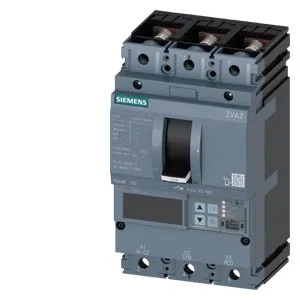
The 3-pole frame handles three-phase loads: motors, heating banks, lighting panels, or a sub-distribution board.
Breaking capacity by voltage — know your SCCR
This MCCB's interrupting rating varies with system voltage: 187 kA at 240 V, 121 kA at 415 V and 440 V, 75.6 kA at 500 V, and 3.7 kA at 690 V. For a 480 V panel (common in North America) the 75.6 kA rating covers most industrial service-entrance requirements. At 690 V the 3.7 kA limit means it's not suitable for high-fault 690 V circuits — you'd need a higher-rated frame for that.
The depth of 86 mm (3.39 in) leaves room for rear-connection bus bars or cable lugs without crowding the enclosure back wall.
Built-in communication and auxiliary switching
This MCCB includes a communication function, so it can report status and trip events to a PLC or BMS over the SENTRON bus system — useful for remote monitoring in a distributed plant. The auxiliary switch configuration (1 auxiliary + 1 trip alarm switch, HP type) provides a dry contact for the breaker's open/closed state and a separate contact that closes only on a trip, so a control system can differentiate between a manual open and a fault. No undervoltage release is fitted, so it won't drop out on a sag — that's by design for line protection where you want the breaker to stay closed unless a fault or manual command opens it.