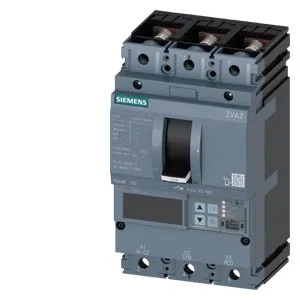
Line protection MCCB with communication and auxiliary switching
The Siemens SENTRON 3VA2163-5JQ32-0HL0 is a 3-pole molded case circuit breaker rated for continuous current of 63 A across the full ambient range from 40 °C to 70 °C — no derating needed up to that ceiling. It is designed for line protection, meaning it sits at the feeder or main distribution point in a panel, not as a motor-protective device. The interrupting capacity tells the real story: 187 kA at 240 V AC, 121 kA at 415 V and 440 V, 75.6 kA at 500 V, and 3.7 kA at 690 V. That 187 kA at 240 V is a high-fault rating — this breaker can handle a substantial short-circuit current without needing an upstream current-limiting fuse, which simplifies coordination in high-capacity switchboards. The adjustable thermal-magnetic trip unit is set from a minimum of 95 A to a maximum of 756 A, with an initial value of 16 A, giving the specifying engineer flexibility to tune the overload and short-circuit thresholds to the protected conductor or bus. This MCCB includes a communication function, a shunt trip release (STL), and a full auxiliary switch complement: 2 auxiliary switches, 1 trip alarm switch, and 1 electrical alarm switch HQ. The trip indicator and voltage trigger are present; undervoltage release is not fitted. Power loss is rated at a maximum of 4 W — negligible for thermal budgeting in a dense panel. Dimensions are 105 mm wide, 181 mm high, and 86 mm deep, fitting standard SENTRON mounting footprints for 3-pole frames in this class.
Panel integration and deployment context
This MCCB mounts on a DIN rail or directly to a mounting plate in a distribution panel or motor control center. The 105 mm width for a 3-pole frame is standard for SENTRON 3VA breakers in this current class, so it drops into existing panel layouts without re-drilling. The operating temperature range is -25 °C to 70 °C, with storage from -40 °C to 80 °C — suitable for unconditioned electrical rooms or outdoor enclosures in temperate climates. The shunt trip (STL) allows remote tripping from an emergency stop circuit or a safety PLC, while the auxiliary switches provide status feedback to a control system. The communication function enables integration with a higher-level monitoring system for energy management or predictive maintenance.
