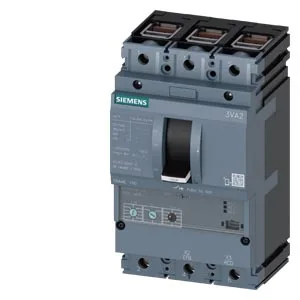
The interrupting capacity hits 187 kA at 240 V, dropping to 121 kA at 415 V and 440 V, then 75.6 kA at 500 V, and 3.7 kA at 690 V. This MCCB includes phase failure detection and a trip indicator, so when a motor phase drops, it opens the circuit and shows you why at a glance. It's built with 2 auxiliary switches plus a trip alarm switch HP — handy for remote status monitoring in a control system.
The 3VA2163-5MN36-0AJ0 measures 105 mm wide, 181 mm high, and 86 mm deep — a standard MCCB footprint for a 3-pole 63 A unit. It's designed for DIN-rail mounting in an enclosure, so it clips onto the rail and connects via busbars or cable lugs. The depth of 86 mm (3.39 in) means it fits in a standard 200 mm deep panel with room for wiring behind it. The width of 105 mm (4.13 in) is the per-pole pitch you'd expect for a 63 A frame — plan your DIN-rail layout accordingly.
The 63 A rating holds steady all the way to 70 °C ambient — that's the thermal derating curve flatlined. In a real panel at 50 °C or 60 °C, you still get the full 63 A, which is unusual for breakers that start dropping current above 40 °C. The trip indicator and phase failure detection are practical for maintenance: when the breaker trips, you see it immediately, and if a phase drops on the motor feeder, it opens the circuit before single-phasing damages the motor. The auxiliary switch complement (2 aux + 1 trip alarm) lets you wire the breaker's status into a PLC or annunciator panel without adding external relays.