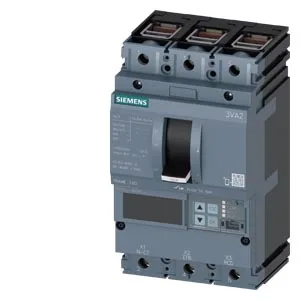
What this MCCB does on the line
Breaking capacity hits 187 kA at 240 V, 121 kA at 415/440 V, and still clears 75.6 kA at 500 V — that's enough for high-fault utility feeds or large transformer secondaries. At 690 V it drops to 3.7 kA, which is typical for a 63 A frame; if your system runs 690 V with high available fault, step up to a higher-rated frame. Communication function is onboard, so this breaker talks to the control system — no separate module needed for status or trip data. The 86 mm depth, 105 mm width, 181 mm height footprint fits standard SENTRON 3VA2 panel cutouts; if you're swapping an older 3VA1 or 3VL frame, check the mounting hole pattern — the 3VA2 series uses the same bolt centers as the 3VA1 but verify lug kit compatibility.
The 63 A frame is sized for motor branch circuits up to about 30 kW at 400 V (typical IEC motor FLC around 60 A for a 30 kW 4-pole). The motor protection design means the thermal-magnetic trip curve is shaped for motor inrush — it holds through a 6-8x starting surge without nuisance tripping. Phase-failure detection trips on loss of one phase, preventing single-phasing damage. Ground-fault monitoring uses summation current on the L conductors, so it catches leakage without a separate GFCI module. The 187 kA interrupting rating at 240 V is the headline number, but the real-world number for most industrial panels is 121 kA at 415 V or 75.6 kA at 500 V — still well above typical 50-65 kA SCCR requirements for motor control centers.