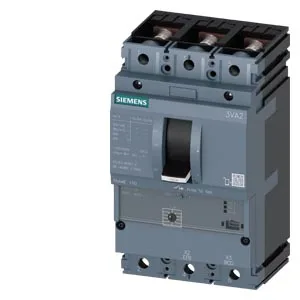
The Siemens SENTRON 3VA2163-7MS32-0AG0 is a 3-pole molded case circuit breaker (MCCB) rated for 63 A continuous current, configured as a starter protection version — meaning it is built to protect motor branch circuits against short-circuit and overload, with the ETU310M electronic trip unit handling the overcurrent release. Breaking capacity is the headline number here: 330 kA at 240 V, 242 kA at 415 V and 440 V, 187 kA at 500 V, and 52.5 kA at 690 V. That 330 kA figure at 240 V means this breaker can safely interrupt a fault current up to 330,000 A without failing — critical for high-fault installations like large transformer secondaries or industrial distribution panels where available fault current is high.
The 63 A rating holds flat from 40 °C through 50 °C ambient. At 55 °C it derates to 60.48 A, at 60 °C to 59.22 A, at 65 °C to 57.96 A, and at 70 °C to 56.7 A. Operating temperature range is -25 °C to 70 °C; storage range is -40 °C to 80 °C. The storage range is wider because the breaker is not dissipating heat when stored — handling, not running, is what that limit governs.
Physical fit and auxiliary wiring
Dimensions: 105 mm wide, 181 mm high, 86 mm deep. Auxiliary contact configuration is 1 auxiliary switch + 1 trip alarm switch (HP version). Trip indicator is present — a mechanical flag that shows the breaker tripped on fault versus being manually switched off, which speeds fault isolation on the line.