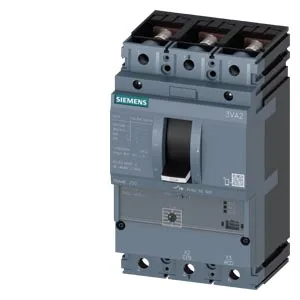
Key ratings and what they mean for fit
The Siemens SENTRON 3VA2220-7MS32-0BL0 is a 3-pole molded case circuit breaker (MCCB) rated for 200 A continuous current, with an ETU310M electronic trip unit configured for starter protection — meaning it coordinates with motor contactors to clear downstream faults before the contactor welds shut. Breaking capacity is 330 kA at 240 V, 242 kA at 415 V and 440 V, 187 kA at 500 V, and 52.5 kA at 690 V — these are the maximum fault currents the breaker can safely interrupt at each voltage level, which drives the upstream transformer and bus bracing requirements in a selectivity study. Rated continuous current holds at 200 A up to 50 °C ambient, then derates to 192 A at 55 °C, 188 A at 60 °C, 184 A at 65 °C, and 180 A at 70 °C — the thermal curve matters when the breaker is mounted in a crowded enclosure with limited airflow. Rated insulation voltage is 800 V, so the breaker is suitable for 690 V line-to-line systems with adequate margin for transient overvoltages.
Auxiliary and release configuration
This variant includes an undervoltage release (UVR) that trips the breaker when control voltage drops below the dropout threshold — standard for motor circuits that must not auto-restart after a power dip. Auxiliary contact complement is 2 auxiliary switches + 1 trip alarm switch + 1 electrical alarm switch (HQ type), giving status feedback for PLC inputs and remote annunciation. Mechanical endurance is rated at 20,000 operations. Maximum power loss is 75 W — factor this into enclosure thermal calculations when grouping multiple breakers.
Physical fit and panel integration
Dimensions are 105 mm wide × 181 mm high × 86 mm deep — the 105 mm width is the standard 3-pole MCCB footprint for this SENTRON frame, so it drops into existing 3VA2 panel cutouts without re-drilling. Operating temperature range is -25 °C to +70 °C; storage range is -40 °C to +80 °C — the storage limit governs handling during shipping and warehouse idle periods, not running conditions. Trip indicator is present — a mechanical flag visible through the front cover shows whether the breaker tripped on fault vs. being manually switched off, speeding fault isolation.
