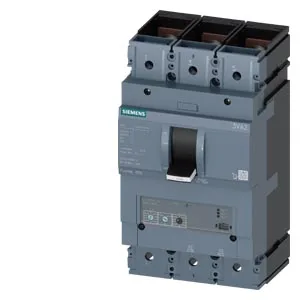
The Siemens SENTRON 3VA2325-5MN32-0JC0 is a 3-pole molded case circuit breaker rated for 250 A continuous at 40 °C, with the same rating holding flat through 70 °C — no derating needed across the normal panel ambient range. The interrupting capacity reaches 187 kA at 240 V, stepping down to 121 kA at 415 V and 440 V, 75.6 kA at 500 V, and 7.5 kA at 690 V. Designed specifically for motor protection, this MCCB includes phase failure detection — it trips on loss of one phase, preventing single-phasing damage to a motor load. No undervoltage release is fitted; if undervoltage protection is needed, that release must be added separately.
The 3VA2325-5MN32-0JC0 measures 248 mm high by 138 mm wide by 110 mm deep — a standard SENTRON 3VA frame size that drops into the same DIN-rail or mounting-plate footprint as other 250 A MCCBs in the series. Width of 138 mm means it occupies three 45 mm pole spaces on a DIN rail, typical for a 3-pole MCCB at this current level.
Operating conditions and power loss
The trip indicator is not fitted on this variant; trip status is read via the auxiliary switches or the shunt trip activation.