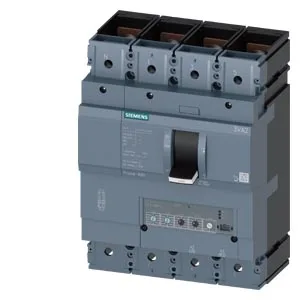
Interrupting capacity hits 187 kA at 240 V, 121 kA at 415 V, and still 9 kA at 690 V, so it handles high-fault utility feeds or transformer secondaries without cascading upstream. The ground-fault monitoring uses summation current formation on L+N, so it's wired for residual sensing on the neutral path.
Dimensions: 248 mm high, 184 mm wide, 110 mm deep. Four-pole frame means it occupies the full width of a standard 600 mm wide panel's backplate if you leave side wiring gutters. No DIN-rail mount — this is a bolted-frame MCCB; plan for busbar or cable lugs on the line and load side. Maximum power loss is 63.5 W, so account for that in the thermal budget if you're stacking breakers in a sealed enclosure.
What the interrupting ratings mean for coordination
At 415 V it's 121 kA, at 500 V it's 75.6 kA, at 690 V it drops to 9 kA. If your transformer secondary or generator bus can deliver more than 9 kA at 690 V, this breaker is not the right choice for that voltage level.