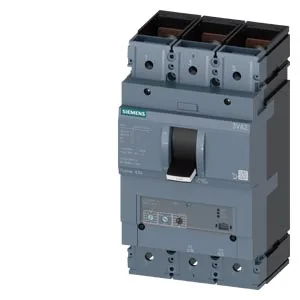
The Siemens SENTRON 3VA2440-5MN32-0DH0 is a 3-pole molded case circuit breaker (MCCB) rated for 400 A continuous current across the full 40 °C to 70 °C ambient range — no derating needed up to that ceiling. That flat thermal curve is the first thing to check when you're packing this into a warm panel or a motor control center with other heat sources. Its interrupting ratings climb to 187 kA at 240 V and hold at 121 kA through 415 V and 440 V, then step down to 75.6 kA at 500 V and 9 kA at 690 V. For a 400 A frame, that's serious fault-current headroom — it'll clear a high-energy arc without cascading upstream, which is what you want when the line feeds a motor starter or a distribution sub-panel. That's enough auxiliary contacts to signal the PLC on trip status and interlock a contactor coil without adding an external relay.
Panel fit & integration
The 110 mm depth (4.33 in) is the number to watch when you're closing the gland plate on a shallow wall-mount box. Maximum power loss is 66 W at full rated current. That's not trivial — if you're grouping several of these in a sealed enclosure, factor the heat into your ventilation or derating calculation.
Auxiliary complement & trip behavior
The basic switch supplied with this order code is 3VA2440-5MN32-0AA0 — that's the core MCCB without the auxiliaries. The -0DH0 suffix adds the undervoltage release (UVR) and the full auxiliary switch pack: two form-C auxiliary switches plus one trip-alarm switch (HQ designation). The trip indicator is mechanical, no voltage trigger needed — it flags visually when the breaker has opened on fault. Short-time withstand is limited to 5 kA for 1 second — that's the rating for selective coordination downstream. If you're building a fully selective distribution, that 5 kA / 1 s figure governs how far you can cascade before the main breaker trips ahead of the branch. The adjustable time-delay range runs from a minimum of 4 s to a maximum of 17 s, which gives you a window to ride through motor inrush or temporary overloads without nuisance tripping.