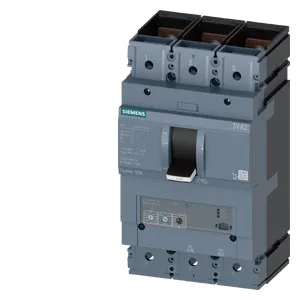
Its 500 A continuous rating at 40 °C (derated to 480 A at 70 °C) matches the full-load current of a large motor, and the 330 kA breaking capacity at 240 V AC means it can interrupt a bolted fault on the secondary side of a step-down transformer without the arc flashing upstream. For a critical-facilities engineer chasing five-nines uptime, that SCCR headroom is the difference between a coordinated trip and a cascading blackout across the switchboard. The undervoltage release (UVR) built into this order code drops the breaker if control power falls below the dropout threshold — a standard requirement for emergency-stop chains and undervoltage protection schemes in motor control centers. Phase failure detection is also onboard, so a lost phase on the line side will trip the breaker rather than let the motor single-phase and cook the winding.
At 138 mm wide by 248 mm tall by 110 mm deep, this MCCB occupies a standard three-pole MCCB footprint on the DIN rail. For a panel OEM wiring up a motor starter section, the 500 A frame size means the line and load conductors will be 2/0 AWG or larger; verify the lug kit accepts the cable diameter you're pulling.
The interrupting ratings span the common industrial voltages: 330 kA at 240 V AC, 242 kA at 415 V and 440 V, 187 kA at 500 V, and 15.3 kA at 690 V. For a site electrical engineer building a selective coordination study, the 242 kA at 415 V means this MCCB can sit downstream of a 250 kVA transformer without exceeding its short-circuit rating.