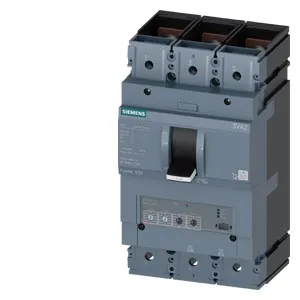
What this 630 A MCCB delivers
The interrupting capacity hits 330 kA at 240 V and still holds 242 kA at 415/440 V, so it handles high-fault utility feeds without cascading upstream. This is the version with a factory-integrated shunt trip (STL) release — the auxiliary trip module is the 3VA9688-0BL30. That means you can remotely trip the breaker via a control signal, which is standard for emergency-stop circuits or interlocking schemes.
Thermal derating and real-world fit
Above that, the breaker derates linearly: 612 A at 45 °C, 593 A at 50 °C, 575 A at 55 °C, 557 A at 60 °C, 538 A at 65 °C, and 520 A at 70 °C. That's a standard SENTRON 3VA2 frame footprint — it bolts into the same mounting pattern as other 3VA2 breakers in this current class.
Trip unit and release details
The ETU350 is an electronic overcurrent release with LSI protection curves (long-time, short-time, instantaneous). It's adjustable, which gives you coordination flexibility downstream. The shunt trip (STL) is a voltage-trigger release — apply rated control voltage and the breaker opens. The breaker does not include a trip indicator, auxiliary contacts, or ground-fault monitoring.