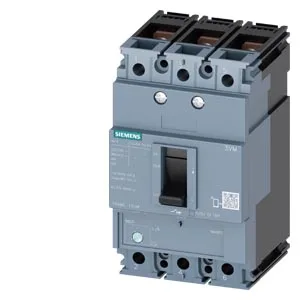
That makes it a straight swap-in for a fixed-trip main breaker where you don't need curve tuning or remote signaling. Rated 160 A continuous at 40 °C, it holds that full rating through 50 °C before starting a gradual derating curve — 158 A at 55 °C, 155 A at 60 °C, 153 A at 65 °C, and 150 A at 70 °C. In a hot enclosure (say, a non-ventilated panel near a furnace line) you lose only 10 A at the top of the operating range, so the thermal margin is solid for most industrial floors. Short-circuit breaking capacity is what drives the coordination study. At 240 V it clears 187 kA; at 415 V it's still 121 kA; at 440 V it drops to 76 kA; at 500 V it holds 17 kA. If your service entrance is a 480 V delta or 400 V wye with a transformer upstream that can deliver over 100 kA fault current, this breaker covers it without cascading to a current-limiting fuse. No undervoltage release, no voltage trip, no ground-fault module, no communication function. It's a basic, high-capacity main breaker: wire it, torque it, forget it.
The 70 mm depth means it fits enclosures with shallow back-pan clearance (typical 4-inch gutters clear it easily). No IP65 or higher rating on the body; keep it inside a sealed cabinet if the environment is wet or dusty.