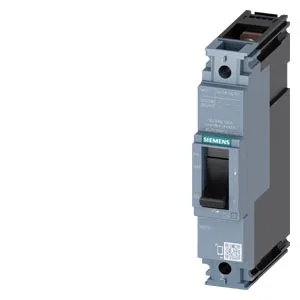
The Siemens SENTRON 3VM1132-4EE46-0AA2 is a 4-pole molded case circuit breaker (MCCB) in the SENTRON family, rated for 32 A continuous current at 40 °C through 50 °C, with a TM220 thermal-magnetic overcurrent release providing LI (long-time and instantaneous) protection. At 415 V the rating drops to 76 kA, and at 500 V to 11.9 kA, which still covers most industrial secondary-distribution faults. The 690 V rated insulation voltage (Ui) means the breaker's internal clearances and creepage are designed for 690 V systems, even though the maximum operating voltage is 500 V AC.
The 32 A rating holds flat from 40 °C to 50 °C, then derates to 31 A at 55 °C and 30 A at 70 °C. That's a gentle slope — you don't lose headroom until the panel ambient pushes past 50 °C. Front connection via box terminals (IP40 on the front face) means the breaker mounts cleanly in a distribution panel with the busbars or cables landing on the front lugs. No auxiliary contacts are fitted (0 CO contacts), and there's no provision for a motor drive or neutral conductor protection — this is a straight line-protection device, not a switch-disconnector with add-ons.