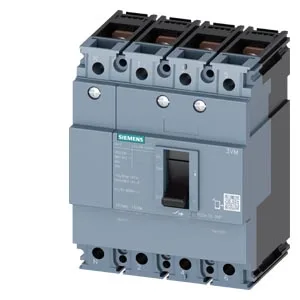
The TM210 designation means the thermal pickup is fixed at 80 A (the frame rating), while the magnetic short-circuit pickup is adjustable between 5x and 10x In — here set to a maximum of 800 A. That gives you a narrow magnetic band for motor or transformer branch circuits where you want to ride through inrush without nuisance trips, but still clear a hard fault fast. Breaking capacity drops with voltage: 76 kA at 240 V AC, 53 kA at 415 V AC, 32 kA at 440 V AC, and 12 kA at 500 V AC. The 4-pole construction handles three-phase plus neutral switching, though this version ships without N-conductor protection (solid neutral only). Rated insulation voltage Ui is 690 V AC, so the breaker is electrically rated for 600 V class panels. Maximum power dissipation is 19 W at full load — plan for that heat in a closed enclosure. Front face protection is IP40, meaning tool-accessible terminals only; no washdown rating here.
Panel integration — footprint and clearance
Dimensions are 101.6 mm wide (4 in), 130 mm tall (5.1 in), and 70 mm deep (2.8 in). The 4-pole width fits standard MCCB mounting patterns; no DIN-rail clip — this is a bolted-down frame breaker. Expect phase-to-phase and phase-to-ground clearance per UL 489 / IEC 60947-2.
Coordination and selectivity context
For selective coordination downstream, the fixed thermal curve and adjustable magnetic pickup (800 A max) give you limited band tuning compared to an electronic trip.