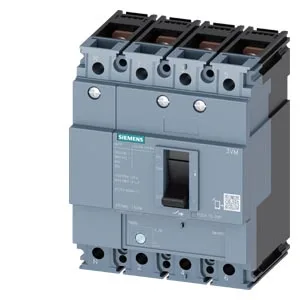
It's a line-protection device, meaning it's sized for feeder or branch-circuit duty where the main job is overcurrent and short-circuit interruption, not motor-starting curves.
At 240 V the interrupting rating hits 121 kA; at 415 V it's 76 kA; at 440 V it's 53 kA; at 500 V it drops to 11.9 kA.
Thermal derating and continuous current
Rated continuous current Iu is 80 A, and the adjustable response value Ir maxes at 80 A as well. The breaker holds 80 A all the way to 50 °C ambient; at 55 °C it's 78 A, at 60 °C it's 77 A, at 65 °C it's 75 A, and at 70 °C it's 74 A. That's a shallow derating curve — you don't lose much headroom in a warm enclosure. The TM220 release is a fixed thermal plus magnetic trip; no electronic adjustment, so what you set on the dial is what you get.
That's a standard 4-pole MCCB width — fits a typical 100 mm DIN-rail or panel-mount cutout.
What's not on this breaker
It's a plain thermal-magnetic line-protection breaker — no electronics to fail, no aux modules to configure. That keeps the failure mode simple: if it trips, it's either overload or short circuit.