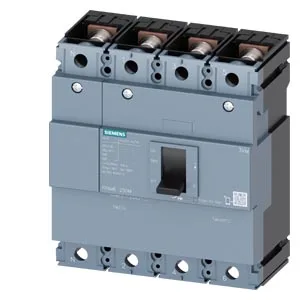
It carries a 200 A continuous rating at 40 °C and uses a TM210 thermal-magnetic overcurrent release — a fixed-trip unit that combines a thermal bimetal for overloads and a magnetic coil for short-circuits, with no adjustable trip settings. The 4-pole configuration handles three-phase plus neutral, common in North American and European 3-phase 4-wire systems where the neutral must be switched or protected. The interrupting capacity tells you where this breaker can be installed safely: 121 kA at 240 V AC, 76 kA at 415 V AC, 53 kA at 440 V AC, and 17 kA at 500 V AC. That 121 kA at 240 V is high enough for most service-entrance or main-switchboard positions on a 240 V delta or 208Y/120 V system. At 415 V it still holds 76 kA, which covers heavy industrial feeders where fault currents can exceed 50 kA. The 500 V rating drops to 17 kA — still adequate for many 480 V panelboards, but verify the available fault current at the point of installation.
Thermal derating — the real-world current limit
The 200 A rating holds flat from 40 °C through 50 °C ambient. Above that it derates: 194 A at 55 °C, 188 A at 60 °C, 182 A at 65 °C, and 176 A at 70 °C. The maximum operating temperature is 70 °C, and storage range is -40 °C to 80 °C.
Dimensions are 70 mm deep, 140 mm wide, 158 mm high. The 140 mm width (5.51 in) is standard for a 4-pole MCCB in this class — it occupies three 18 mm pole spaces plus one neutral pole.
Key design details
That makes it a straightforward choice for fixed-load feeders where coordination studies are done once and don't require field adjustment.