Breaking capacity — what the voltage columns mean for your fault level
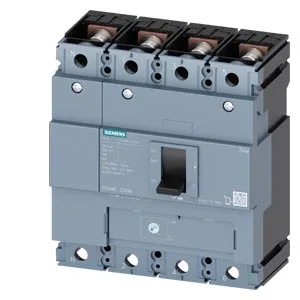
The 3VM1225-5GE42-0AA0: This MCCB delivers 187 kA at 240 V, 121 kA at 415 V, 76 kA at 440 V, and 30 kA at 500 V. The 240 V figure covers most North American 120/208 V and 277/480 V panelboards at the line side; the 415 V column matches common IEC 50 Hz industrial networks. At 500 V the 30 kA rating still clears high-fault scenarios in motor control centers.
At 55 °C it derates to 243.3 A, at 60 °C to 236.5 A, at 65 °C to 229.8 A, and at 70 °C to 223 A. The thermal-magnetic TM220 release responds to both overload and short-circuit; no undervoltage release or ground-fault module is fitted as standard.
The 4-pole body occupies a standard MCCB footprint — no oddball cutout. The N-conductor is protected at 100% (full-rated), meaning the neutral pole carries the same continuous current as the phases.