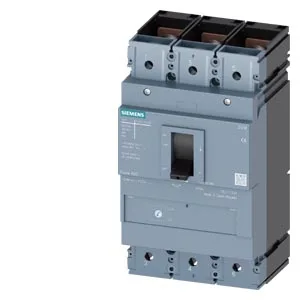
Siemens 3VM1463-4EE32-0AA0 — 630 A SENTRON MCCB, TM220 Release
It uses a TM220 thermal-magnetic overcurrent release — the fixed thermal element handles overloads, the magnetic element clears short-circuits, and the 220 designation indicates the magnetic pickup is fixed at 10× In (6,300 A). The interrupting capacity reaches 121 kA at 240 V AC and 76 kA at 415/440 V AC, which gives solid headroom for most industrial distribution panels without cascading upstream.
Current Derating and Thermal Performance
Above that, the thermal element begins to derate: 618 A at 55 °C, 607 A at 60 °C, 595 A at 65 °C, and 583 A at 70 °C. Maximum power dissipation at rated load is 193 W, which must be factored into the enclosure's thermal budget. The storage limits govern handling and warehousing, not running conditions.
The 3VM1463-4EE32-0AA0 delivers 121 kA at 240 V, 76 kA at 415 V and 440 V, and 53 kA at 500 V. These are symmetrical RMS values. At 415 V, the 76 kA rating covers most utility transformer secondary faults in industrial plants. The TM220 release's fixed magnetic threshold means selectivity with downstream breakers is determined by the thermal curve overlap — coordination studies should verify the let-through energy (I²t) at the fault level.