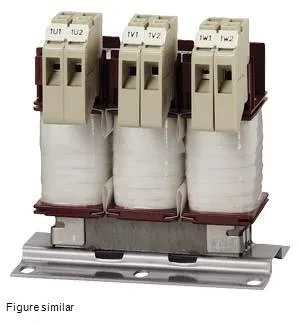
What this choke does in the circuit
The Siemens 4EP3600-7DS00 is a three-phase commutating choke (line reactor) for converter drives. Its job is to limit current rise and reduce harmonics on the line side of a variable-frequency drive or DC drive. Rated at 14.4 A continuous with a maximum of 16 A, it sits between the supply and the converter input — typically on a 400 V AC, 50 Hz three-phase line. The 1.8 mH inductance and 4% relative inductive voltage drop give it the right impedance to smooth the current pulses a six-pulse rectifier pulls. That 4% figure is the design target; too low and the choke does nothing, too high and you lose too much voltage headroom for the drive's DC bus. Total power loss runs 47.8 W — 39 W in the copper winding and 8.8 W in the iron core, both at the 40 °C ambient rating. That heat has to go somewhere; IP00 means no enclosure, so this choke is meant for a ventilated cabinet or a dedicated electrical room where the heat can rise out. Thermal class B insulation (130 °C) gives a reasonable margin above the 40 °C ambient, but you still need to keep the surrounding air moving — don't bury it in a sealed box with other hot gear. That's fine for a fixed installation where you torque once and leave it. The 0.078 m depth, 0.148 m width, and 0.139 m height footprint fits a standard sub-panel layout; allow clearance above for airflow and below for the terminal access. If you're swapping an older choke or a different brand, check the mounting centres — the foot print is compact enough to retrofit into most 3-phase line-reactor bays.
DC rating matters for regenerative drives
One spec that catches people: the DC rated value is 19.6 A, higher than the AC 14.4 A. That's because the choke is also rated to handle DC current in the converter's DC link — useful if the drive has a regenerative braking chopper or if you're using the choke on the DC side of a four-quadrant drive. The AC rating is the one you use for line-side duty; the DC number tells you the choke can take the ripple current plus the DC bias without saturating the core.