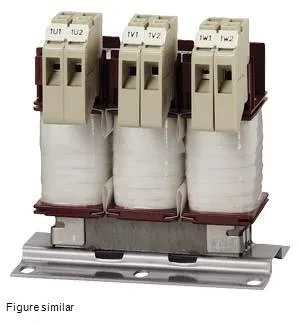
What this reactor does on the line
The Siemens SIDAC 4EP3706-0FS01 is a 3-phase output reactor (choke) rated for 500 VAC, with a rated frequency of 4 kHz and an inductance of 2.5 mH. It sits between the drive output and the motor cable, limiting the rate of voltage rise (dV/dt) and reducing capacitive charging currents in long cable runs — a common fix for nuisance tripping on older drives or installations with poor cable shielding. Open-frame construction (IP00) with screw-type terminals means it mounts inside a cabinet, not in a wet environment. The thermal class F (IEC 60085) winding and 16.3 W coil losses at 40 °C ambient tell you it dissipates heat into the panel air — keep some breathing space around it.
Fit and dimensions — panel integration note
The 4EP3706-0FS01 measures 0.17 m wide by 0.15 m tall by 0.1 m deep. That's a compact footprint for a 3-phase reactor at this rating — roughly the size of a small DIN-rail power supply. It's not a DIN-rail snap-on part; the screw terminals expect a fixed mounting plate or a sub-panel inside the enclosure.
Rated inductance of 2.5 mH at the 4 kHz switching frequency gives enough impedance to smooth the drive output waveform for motor cable runs up to about 50–100 m, depending on cable capacitance. The 0–8000 Hz operating range (4 kHz rated) covers most standard IGBT drive switching frequencies. The description lists a UK (%) of 6.5% — that's the voltage drop at rated current, a standard figure for output reactors sized to protect the motor without robbing too much torque. Combined with 12.4 W iron-core losses and 16.3 W coil losses, total dissipation is under 30 W at full load, manageable in a ventilated cabinet.