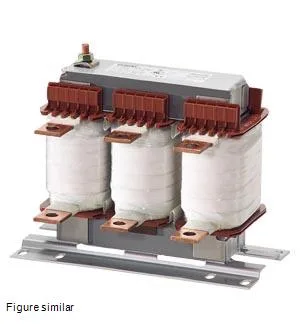
The Siemens 4EP3802-2DS00 is a commutating choke (also called a line reactor) designed for converter applications. It sits between the supply and the drive input, smoothing current and limiting harmonics. Rated for 31.5 A continuous on a 3-phase AC system at 500 V and 50 Hz, it handles the switching transients that come off a variable-frequency drive. At DC the choke is rated 42.8 A — useful if the converter topology includes a DC link that needs filtering on the bus side. Power loss splits into 45 W in the coil and 18 W in the iron core, for a total of 63 W at rated load. That heat has to go somewhere — the IP00 rating means no enclosure, so the choke is meant to be mounted inside a panel or cabinet where the heat can rise out. Ambient temperature rating is 50 °C, which is realistic for a warm control room but tight if you're stuffing it next to a hot drive in a sealed box.
Because it's a mature product, availability is generally stable, but it's not a high-turnover commodity — expect to quote it to order rather than pull it off a shelf.
The choke measures 0.178 m wide, 0.153 m tall, and 0.12 m deep — roughly 178 x 153 x 120 mm. That's a substantial footprint for a panel layout; it's not a DIN-rail snap-on, so plan for a dedicated mounting plate or chassis. Thermal class B per IEC 60085 means the insulation system is rated for a maximum hot-spot temperature of 130 °C. That's standard for industrial chokes and gives you some margin if the panel ambient climbs above 40 °C, but keep the 50 °C ambient limit in mind — derate or add forced ventilation if the cabinet runs hotter.