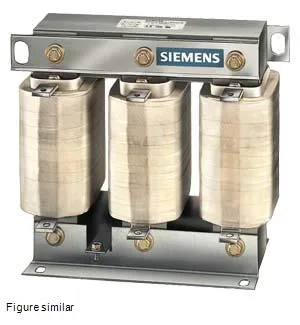
The Siemens SIDAC 4EP4010-0MS10 is a three-phase output reactor — an inductive choke placed between a variable-frequency drive and the motor to smooth the PWM waveform and limit voltage spikes on the motor windings. Rated for 76 A maximum continuous current and a 4 kHz switching frequency, with 0.1 mH inductance per phase, it protects the motor insulation from the sharp edges of a VFD output and reduces bearing-fluting currents in longer cable runs.
The 76 A maximum rating is the thermal current the reactor can carry continuously at 40 °C ambient, thermal class B (130 °C rise). For a drive running a motor at 68.4 A continuous (the listed I LN value), this reactor has headroom above the nominal load. The 4 kHz switching frequency matches the typical IGBT switching speed of many general-purpose VFDs. If your drive runs a higher carrier frequency, the reactor's core losses increase — derate the current or check the drive manufacturer's recommendation. Power loss splits into 42 W in the coil (copper losses from the winding resistance) and 33 W in the iron core (hysteresis and eddy-current losses). At 75 W total, it's warm but manageable in a ventilated enclosure — plan for some airflow around it.
Mount the reactor in the motor-output path between the VFD terminals and the motor cable. The free cable endings (stripped conductors) need to be terminated into a terminal block or directly to the drive and motor — no connector on the reactor itself. Dimensions are 0.21 m wide, 0.17 m high, and 0.14 m deep — roughly the size of a large brick. It's a panel-mount component; leave clearance around it for heat dissipation and cable bending radius.