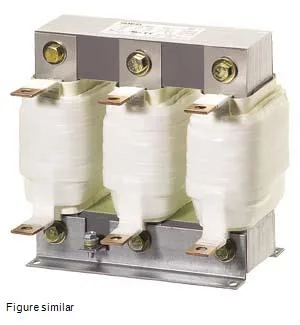
The SIDAC 4EU3032-8MA08-0AA0 is a 3-phase filter reactor — a line reactor — built to sit between your drive and the motor leads, or on the line side of a VFD, knocking down harmonic distortion and limiting inrush current. Rated 55.4 A continuous, with a maximum of 61.6 A, it's sized for a motor load around that amp draw on a 400 V, 50 Hz supply. The 14% relative throttling factor means it drops about 14% of line voltage at rated current — that's enough to clean up harmonics from a 6-pulse drive without starving the motor of torque. Inductance is 0.0021 H, and the reactive power of the filter bank is rated 40,000 var. Power loss runs 269 W at full load — that's heat you need to vent. The unit is IP00, so it's an open-frame choke meant for a clean, dry cabinet, not a washdown area. Thermal class H insulation (rated for 180 °C hot-spot) gives it headroom in a warm enclosure, but you still need airflow. Ambient temperature rating is 40 °C; push past that and you'll want to derate or add forced ventilation. Plan for a screwdriver and a torque wrench on the install. Dimensions: 0.3 m wide, 0.269 m tall, 0.211 m deep. That's about 12 by 10.6 by 8.3 inches — it'll eat some real estate on the backplate or DIN-rail assembly.
Where It Goes — Deployment Context
The IP00 rating means it's strictly indoor, cabinet-mounted — no outdoor or washdown duty. The 134 Hz resonant frequency of the filter means it's tuned to avoid the common 5th and 7th harmonic frequencies from a 6-pulse rectifier, so it won't sing or overheat when those harmonics are present.