What the D-curve and breaking capacity mean for your panel
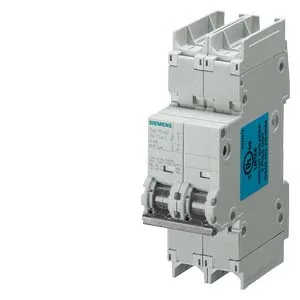
The Siemens 5SJ4211-8HG41 is a 2-pole SENTRON miniature circuit breaker with a D tripping characteristic, designed to handle the high inrush currents typical of motor loads, transformers, and inductive machinery without nuisance tripping. The D-curve trips between 10× and 20× rated current, so it holds through the magnetizing surge of a conveyor drive or a packaging-line servo and clears a hard fault fast. Breaking capacity is dual-rated: 10 kA per EN 60898 for residential/commercial branch circuits and 15 kA per IEC 60947-2 for industrial panel coordination — the higher figure is the one to use when sizing SCCR on a machine-tool or process-line distribution board. Rated 400 V AC and 60 V DC, it covers common three-phase control voltages and DC auxiliary circuits in the same package. The 36 mm width (2 modular units) snaps onto standard DIN rail in any mounting position, which simplifies layout when you're packing breakers into a tight enclosure alongside contactors and drives.
Integration and environment
Mounts on standard 35 mm DIN rail with a 70 mm installation depth, leaving room for wiring behind the panel door. The housing carries IP20 protection with connected conductors and IP40 in the handle area — adequate for enclosed industrial panels but not for washdown zones. Ambient temperature range spans -40 °C to 75 °C, so it works in unheated warehouses or near oven lines without derating concerns. Terminal tightening torque is specified at 3.5 Nm for copper conductors rated 60/75 °C. Pollution degree 3 and overvoltage category III suit it for fixed installations in industrial environments where conductive dust or condensation may occur. The breaker is halogen-free and silicon-free, which matters for sensitive environments like semiconductor fabs or clean-room packaging lines.