What it is and what the ratings mean
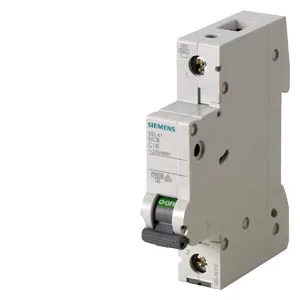
The Siemens SENTRON 5SL4110-7CC is a 1-pole miniature circuit breaker with a C tripping characteristic, rated 10 A and a breaking capacity of 10 kA according to EN 60898 at 400 V AC. The C-curve means it trips between 5 and 10 times rated current — standard for protecting inductive loads like small motors, lighting ballasts, and transformer primaries where inrush is higher than a resistive load but not extreme. The 10 kA breaking capacity tells you it can safely interrupt a fault current up to 10,000 A without welding contacts or cascading failure upstream; that's the standard residential and light commercial fault level in most European and Asian distribution boards. It occupies 1 modular width unit (18 mm) on a DIN rail, so it fits a standard 18 mm-per-pole panel layout. Rated for single-phase operation up to 250 V AC and multi-phase up to 440 V AC, it handles both 230/400 V split-phase and 400 V three-phase networks. The supply frequency is 50/60 Hz, covering both mains standards globally. For DC circuits, the maximum rated voltage is 72 V — useful for control circuits but not for high-voltage DC bus protection. The IP20 rating (with connected conductors) means it's protected against solid objects larger than 12 mm but not against moisture — standard for enclosed distribution boards. It's rated for pollution degree 2 and overvoltage category III, which is the normal environment inside a building's main or sub-distribution panel.
Where it goes and how it mounts
Snaps onto a standard 35 mm DIN rail. Depth is 76 mm, height 90 mm, width 18 mm (1 MWU). Installation depth is 70 mm, so it clears most standard enclosure back panels. Mounting position is any — no derating needed for horizontal or upside-down orientation. The terminals accept supplementary devices (shunt trip, auxiliary contacts, alarm switch) for remote signaling or emergency off. Power loss is 0.9 W per pole at rated current in hot operating state — negligible for thermal budgeting in a populated panel, but worth noting if you're packing 40+ breakers in a sealed enclosure. Vibration resistance is 50 m/s² at 25 to 150 Hz per IEC 60068-2-6, so it holds up on machine-mounted sub-panels near rotating equipment.
How it compares to the 3-pole sibling
The 5SL4363-7 is the 3-pole version of the same breaker family — same depth (76 mm), height (90 mm), C-curve, 10 kA breaking capacity per both EN 60898 and IEC 60947-2, and same 400 V AC rating. The key difference: the 3-pole unit occupies 3 MWU (54 mm wide) and dissipates 5 W per pole in hot state. If your panel was laid out for 5SL4363-7, the 1-pole 5SL4110-7CC will not drop in without rewiring — the pole count and busbar arrangement are different. But within a single-phase branch circuit, the 5SL4110-7CC is the correct 1-pole choice.
