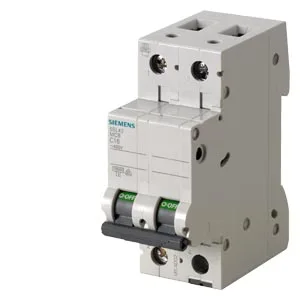
The Siemens 5SL4204-8CC is a SENTRON miniature circuit breaker (MCB) with a D tripping curve, 2 poles, and a 4 A rated current at 400 V AC. It interrupts fault currents up to 10 kA per EN 60898, which means it safely clears a short-circuit without cascading upstream — a standard requirement for residential and infrastructure sub-distribution boards. The D curve means it tolerates the high inrush of motor or transformer loads without nuisance tripping, so it is the right choice for circuits feeding small pumps, compressors, or lighting ballasts, not for general lighting or socket outlets where a B or C curve would be the norm.
Ratings and what they mean for fit
Rated 4 A at 30 °C, but derates to 3.79 A at 40 °C, 3.68 A at 45 °C, 3.56 A at 50 °C, and 3.45 A at 55 °C (–). If your panel ambient runs at 50 °C, the breaker is good for 3.56 A continuous — not 4 A. That derating is the number that governs the real load, not the 30 °C nameplate. The 10 kA breaking capacity at 400 V AC is the maximum fault current it can interrupt; verify the prospective short-circuit current at the installation point does not exceed that. For DC circuits, the maximum rated voltage is 72 V — so it can switch a 48 VDC control bus but not a 125 VDC battery bank. Overvoltage category III and pollution degree 2 confirm it is rated for fixed-installation use in a standard industrial or commercial environment. The 2-pole design switches both phase and neutral on a single-phase circuit, or two phases on a three-phase system. It occupies 2 modular width units on a DIN rail — 36 mm wide — and mounts in any position, which simplifies panel layout. Installation depth is 70 mm, overall depth 76 mm. Touch protection is built in, and the housing is sealable for tamper-proofing in metering or rental applications.
Compliance and documentation
Designed to EN 60898 for the 10 kA rating. The SENTRON series carries CE marking and is UL/CSA recognized for the North American market (standard for the series, though not explicitly listed in this evidence). The housing is halogen-free and silicon-free, which matters for panels in clean-room or corrosive environments where outgassing is a concern. Vibration resistance is tested to 50 m/s² at 25 to 150 Hz per IEC 60068-2-6 — sufficient for mounting on machinery or in transportable enclosures.