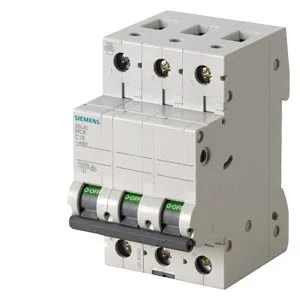
Siemens 5SL4304-0RC — 3-Pole MCB (DIN Rail)

Siemens Betagard 5SL4304-0RC MCB, 4A Z-Curve 3-Pole 10kA

MPN5SL4304-0RC

Siemens Betagard miniature circuit breaker, 5SL4304-0RC, 3-pole, 4 A rated, Z tripping characteristic, 10 kA breaking capacity per EN 60898, 15 kA per IEC 60947-2, 415 V AC, IP20.

Sourced new & surplus through independent channelsAuthenticity-screened · ESD-safe packingListing updated Aug 2026

Specifications

5SL4304-0RC — Identification
ParameterValue
Brand nameBetagard
Number of poles3
Pole configuration3P
5SL4304-0RC — Protection
ParameterValue
Tripping characteristic (curve)Z
Breaking capacity per EN 6089810 kA
Breaking capacity per IEC 60947-215 kA
Overvoltage categoryIII
IP protection classIP20, with connected conductors
Pollution degree3
5SL4304-0RC — Electrical
ParameterValue
Rated current (AC)4 A
Rated voltage (AC, multi-phase)440 V
5SL4304-0RC — Mechanical
ParameterValue
Modular width units3
Mounting positionany
Width54 mm
Height90 mm
Depth76 mm
Installation depth70 mm
Terminal tightening torque, max.75 °C
Terminal tightening torque, min.-40 °C
SealableYes
5SL4304-0RC — Environmental
ParameterValue
Halogen-freeYes
Silicone-freeYes

Product details

What you're looking at — and what the Z-curve means for your panel

The 5SL4304-0RC is a Siemens Betagard miniature circuit breaker — 3-pole, 4 A rated at AC, with a Z tripping characteristic. That Z-curve is the key spec: it trips between 2x and 3x In (8 to 12 A magnetic release), which is tighter than a B-curve and much tighter than C or D. Z-curve MCBs are built for semiconductor and control-circuit protection where you need short-circuit clearing without nuisance trips on small transformer inrush or capacitive loads, but still want fast reaction to a fault. At 415 V AC rated voltage, with a maximum of 440 V AC for multi-phase operation, it covers standard European 400 V three-phase distribution.

Panel fit and mounting — the 3-module width and derating reality

Mounting position is any — no orientation restrictions. Thermal derating is published: 4.5 A at 30 °C, 4.2 A at 40 °C, 4.1 A at 45 °C, 4 A at 50 °C, 3.9 A at 55 °C, 3.7 A at 60 °C. If your panel ambient runs 50 °C, you're at the nameplate 4 A — no headroom. At 60 °C you lose 0.3 A off the rating. That's the figure to use for continuous load sizing, not the 30 °C number.

DC rating and vibration — edge cases that matter

Maximum DC rated voltage is 72 V — useful if you're breaking a 48 V or 60 V control bus, but not rated for 110 V DC circuits.

Sourcing this order code

If you're filling a BOM line or replacing a failed unit in a live panel, send the order code and quantity for a firm quote.

Frequently asked questions

What does the Z tripping characteristic mean for my application?

Z-curve trips magnetically at 2x to 3x In (8 to 12 A for this 4 A breaker). That's designed for semiconductor protection and control circuits where you need fast fault clearing but want to avoid nuisance trips from small transformer inrush or capacitive loads.

What is the breaking capacity of the 5SL4304-0RC?

10 kA per EN 60898 and 15 kA per IEC 60947-2. For industrial panel coordination, use the IEC 60947-2 figure.

What is the rated voltage for this MCB?

415 V AC rated, with a maximum of 440 V AC for multi-phase operation. DC rated voltage is 72 V maximum.

Where can I buy the 5SL4304-0RC?

Sourced and quoted to order against an RFQ through independent distribution. Send the order code and quantity for a firm quote on availability and pricing.

Will the 5SL4304-0RC drop into a panel specified around the 5SL3340-7CC?

Both are 3-pole Siemens MCBs on the same DIN-rail footprint, but the 5SL3340-7CC is a different current rating and tripping characteristic. Check the panel's coordination study — the Z-curve on this part trips faster than a B or C curve, so selectivity with downstream devices may shift.

MPN
5SL4304-0RC