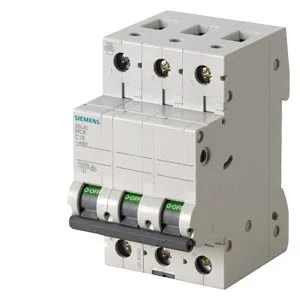
The Siemens SENTRON 5SL4332-8 is a 3-pole miniature circuit breaker (MCB) with a D tripping characteristic, rated 32 A at 400 V AC. It delivers a 10 kA breaking capacity under both EN 60898 and IEC 60947-2, which means it can safely interrupt fault currents up to that level on a 400 V distribution board — no cascading upstream breakers needed for most residential and light commercial panels.
D-curve and deployment context
The breaker tolerates a short-duration surge without nuisance tripping, then clears a sustained overload. Rated for 50/60 Hz supply and overvoltage category III, it mounts in any position on a DIN rail, occupying 3 modular width units. The 76 mm depth and 54 mm width match the standard SENTRON 5SL family footprint, so it slots into existing distribution boards without re-spacing.
The 10 kA SCCR at 400 V AC is the same under both EN 60898 (household) and IEC 60947-2 (industrial) standards — a single rating that satisfies both compliance paths. The D curve vs. the more common C curve is the key decision: if your load is a motor or a transformer bank, D avoids nuisance trips. If the load is resistive or general-purpose, a C-curve sibling like the 5SL4363-7 would trip faster on overload. The 5SL4332-8 runs at 2.7 W power loss per pole in hot operating state — negligible for panel thermal budgeting, but worth noting if you're packing 40+ breakers in a sealed enclosure.