What it is and where it lands
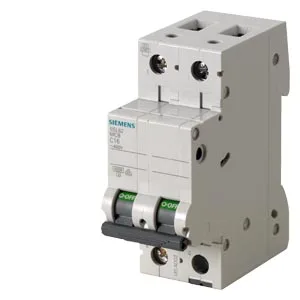
The Siemens SENTRON 5SL6202-7BB is a 2-pole miniature circuit breaker (MCB) with a C tripping characteristic, rated at 2 A and 400 V AC. It snaps onto a DIN rail in a distribution board or sub-panel, occupying 2 modular width units (36 mm). The C-curve means it trips between 5 and 10 times rated current — the standard choice for moderate inrush loads like small motor starters, lighting banks, and transformer primaries in residential and light commercial infrastructure. Breaking capacity is 6 kA per both EN 60898 and IEC 60947-2, which covers most domestic and commercial fault levels. The 6 kA rating at 400 V AC means it can safely interrupt a short-circuit fault up to that prospective current without welding contacts or cascading failure upstream — a key coordination figure for the panel designer. The enclosure is rated IP20 with connected conductors — standard for enclosed distribution boards where the breaker is behind a cover. It is sealable, halogen-free, and silicon-free, which simplifies compliance documentation for projects that restrict those materials.
Sourcing and lifecycle posture
No official successor has been published because none is needed — the part is still in the active portfolio. If you are managing a consignment bin or a kanban signal for this code, the replenishment rhythm is steady; no last-time-buy window to watch for.
Panel fit and integration notes
Dimensions are 90 mm high, 36 mm wide (2 MW), and 76 mm deep, with an installation depth of 70 mm behind the panel face. Mounting position is any orientation, which simplifies layout in tight enclosures. Pollution degree 2 and overvoltage category III are standard for fixed-installation distribution boards. The breaker accepts supplementary devices (auxiliary switches, shunt trips, alarm contacts) — the product extension feature is enabled, so you can add remote signaling or trip indication without replacing the base unit. Power loss is 1.2 W per pole at rated current in hot operating state, a figure to include in thermal calculations for a densely populated enclosure. Mechanical service life is 10 000 operating cycles typical, which is adequate for a protection device that operates infrequently; this is not a switching-duty contactor. The DC rating maxes out at 72 V, so it can serve low-voltage DC branch circuits within that limit.