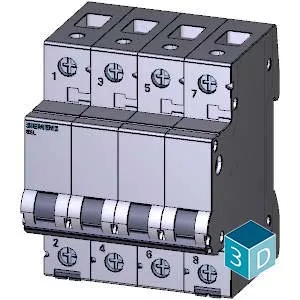
The Siemens 5SL7420-3RC is a 4-pole miniature circuit breaker (MCB) rated at 20 A with a K-trip characteristic and a 15 kA breaking capacity. The K curve is designed for motor and transformer loads where inrush currents are higher than resistive loads — it holds through the start-up surge without nuisance tripping, then clears fast on a hard fault. The 15 kA short-circuit rating means it can safely interrupt faults up to that level on a 400 V three-phase panel, which covers most industrial distribution boards fed from a standard transformer.
Snaps onto standard 35 mm DIN rail inside a distribution board or control panel. Four-pole width (72 mm at 18 mm per pole) means it occupies four module spaces. The K characteristic is the deciding spec for motor branch circuits — if the load is a pump or fan with a DOL start, this holds the inrush; if the load is lighting or a resistive heater, a B or C curve would be a tighter fit. Terminal capacity accepts up to 25 mm² conductor.
The 15 kA breaking capacity at 400 V AC is the key coordination figure for the panel designer — it determines the upstream fault level the MCB must clear without welding contacts or failing to interrupt. For a typical 630 kVA transformer with around 20 kA prospective fault current at the main board, this MCB needs a current-limiting upstream device or a higher-rated MCCB ahead of it to stay within its 15 kA rating. Standard practice: verify the available fault current at the point of installation before committing the BOM line.