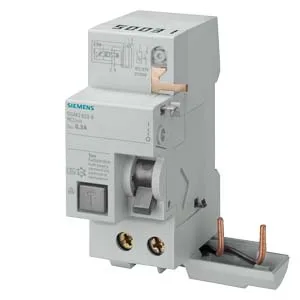
The 300 mA tripping threshold is deliberately higher than the 30 mA used for personal shock protection; this is a selective (time-delayed) unit, so it coordinates with downstream 30 mA RCDs by letting them clear a fault first before this one trips, keeping the main distribution board live during a branch fault. Rated at 63 A continuous on a 230/400 V AC supply, this RC unit handles the full load of a sub-distribution board or a heavy feeder circuit. The 2-pole design switches both phase and neutral on a single-phase supply, or two phases on a three-phase system where neutral protection isn't required. It mounts on DIN rail (REG profile) and takes up 2 width units — about 36 mm of rail space — so it fits standard distribution boards without crowding.
The screw-type terminals accept both solid and stranded conductors from 1.5 mm² up to 25 mm². That's a wide grip range — the 25 mm² top end means you can feed a 63 A submain directly without a reduction ferrule. Tightening torque is 2.5 to 3 N·m, which is in the usual range for this class; a torque screwdriver set to 2.8 N·m is a safe middle value.
Mechanical endurance and testing
Rated for 10,000 mechanical switching cycles, which is standard for a fixed-installation RCD — this isn't a daily-switched device, but it will handle periodic manual testing and the occasional fault clearing without wearing out. The test circuit requires a minimum of 195 V AC to operate the test button, so verify the supply voltage on site before relying on the monthly test function.