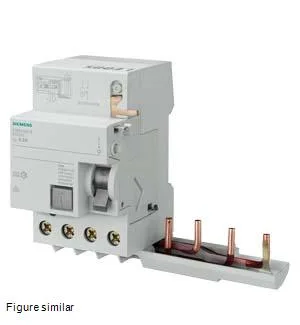
RCD unit for selective earth-fault protection
The Siemens SENTRON 5SM2645-2 is a 4-pole selective residual current device (RCD) rated 63 A at 400 V AC, 50 Hz, with a fixed trip threshold of 300 mA, type AC. Selective design means it delays tripping to coordinate with downstream RCDs — only the faulted branch clears, keeping the rest of the distribution board live.
The 300 mA rated fault current is not adjustable, and the OFF-delay time is fixed — this is intentional for the selective role: it sits at the supply side of a sub-distribution board, coordinating with 30 mA RCDs downstream. Type AC means it detects sinusoidal AC residual currents only; if the installation includes non-sinusoidal waveforms (rectifiers, VFDs), a type A or B RCD would be required. Insulation voltage is rated 460 V, overvoltage category III, pollution degree 2 — standard for fixed-installation distribution boards in commercial and industrial buildings. Surge voltage withstand is 4 kV, which matches the impulse voltage expected at the service entrance of a building.
IP20 is the protection class with conductors connected and the distribution board installed — meaning the front face is touch-safe, but the unit is not sealed against moisture or dust ingress. Supply can enter from top or bottom; the unit is not sealable (no provision for a lead seal on the adjustment cover).