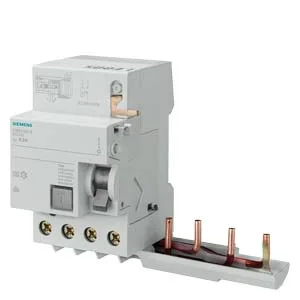
It's built to trip on sinusoidal AC fault currents at the 300 mA threshold, making it a fit for general-purpose protection in distribution boards where the load side doesn't generate pulsed DC fault signatures — think resistive heating, basic motor circuits with no VFD, or older lighting banks. Rated at 63 A AC and 460 V insulation voltage, it handles a 50 Hz supply across four poles.
Thermal derating — what the 63 A rating actually means in a warm panel
Above that, the device derates linearly: 58.6 A at 45 °C, 56.7 A at 50 °C, 54.81 A at 55 °C, 53.55 A at 60 °C, 52.29 A at 65 °C, and 50.4 A at 70 °C. The -40 °C to 75 °C storage range is wider than the operating derating curve covers.
Snaps onto DIN rail (REG fastening method), occupies 3 modular width units. The IP20 rating applies when installed in a distribution board with conductors connected — so it's a panel-internal device, not for standalone outdoor use.