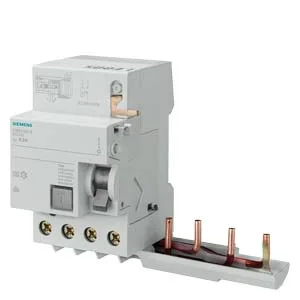
The Siemens 5SM2646-2 is a 4-pole residual-current device (RCD) from the SENTRON family, designed as a selective (time-delayed) type AC unit. The selective design means it coordinates with downstream RCDs — it holds during short-duration earth faults, letting the closer device trip first, so only the faulted branch drops out. That makes it the right choice for a distribution board feeding multiple sub-circuits where you want continuity on the main bus.
Rated at 63 A and 300 mA sensitivity, this RCD sits at the incoming side of a sub-distribution board or as a main switch RCD in a residential or light commercial panel. The 400 V AC rating covers three-phase 4-wire systems (-L2-L3-N) at line-to-line voltage. Overvoltage category III means it is rated for fixed-installation use downstream of the utility meter, not for plug-in portable gear. The 4 kV surge voltage resistance confirms it withstands typical switching and lightning-induced transients in a building distribution network. The 3 MW modular width (each MW = 18 mm) means it occupies three 18 mm slots on a DIN rail, so 54 mm of rail space. Depth is 70 mm, which is standard for SENTRON RCDs and fits most 125 mm deep enclosures without crowding the gland plate.
Fastening method is REG (regular snap-on). Any mounting position is permitted. The unit is not sealable — no provision for a lead seal or lockout hasp. Operating temperature range is -5 °C to 45 °C; storage range is -40 °C to 75 °C, so it handles cold warehouses before installation but needs a heated panel if the ambient drops below -5 °C in service. Pollution degree 2 (non-conductive dust, occasional condensation) covers normal indoor electrical rooms. That matters for thermal management in a densely populated enclosure — ensure free air circulation or derate if adjacent devices are also near their thermal limits.