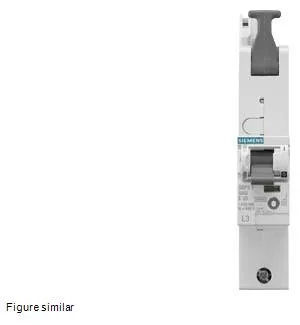
It's designed for residential and infrastructure metering panels — specifically as the main breaker ahead of the meter, installed on a 40-mm busbar system per DIN 43870 Part 2. The E curve means it handles moderate inrush without nuisance tripping, typical for general lighting and socket circuits in European domestic boards.
Breaking capacity is 25 kA at 230/400 V per EN 60898 — that's the standard for residential main breakers in most of Europe, so it coordinates with the utility-side fault level without needing an upstream fuse. The 25 kA rating also appears as the rated value per EN 60898, confirming it's tested to that standard. Overvoltage category IV means it's rated for the utility connection point, not just sub-distribution. Wire range covers 2.5 to 50 mm² solid or stranded — that's enough for a 35 A feed with some headroom on the line side. The box terminal infeed and spring-loaded outgoing terminal make wiring straightforward in a meter cabinet. Mechanical life is 20 000 switching cycles typical — fine for a main breaker that sees infrequent operation. Shock resistance is 30 g, 11 ms duration, and vibration resistance is 2 g per IEC 60068-2-6, so it holds up in transport and light industrial environments.
Mounts on a 40-mm busbar system per DIN 43870 Part 2 — that's the standard for European meter panels. The 1.5 width units (about 27 mm) fit in a single module space. Depth is 76.3 mm, which fits standard meter cabinets. The switch position indicator shows OFF = green, ON = red, a quick visual check during commissioning or troubleshooting.