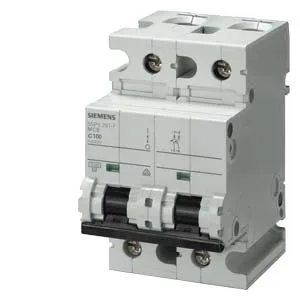
What this 125 A C-curve MCB does in the panel
The Siemens 5SP5292-7 is a 2-pole SENTRON miniature circuit breaker rated 125 A at 400 V AC with a C tripping characteristic — meaning it trips between 5 and 10 times rated current, which is the standard choice for motor circuits, transformers, and capacitive loads where inrush is higher than a B-curve would tolerate. On the DC side it breaks 10 kA per EN 60898-2 and 15 kA per IEC 60947-2, so it handles the fault energy on a 440 V DC bus without cascading upstream.
Mounts in any position on standard mounting rail or with screw fixing. Tunnel terminals top and bottom accept the conductors. Sealable design allows the panel builder to lock the toggle position after commissioning.
The C-curve (5–10× In) means it will hold through the inrush of a 125 A motor or transformer bank without nuisance tripping, but still clears a short-circuit fast enough to protect downstream cable. On the DC side, the 10 kA (EN 60898-2) and 15 kA (IEC 60947-2) ratings cover most industrial DC bus applications up to 440 V — common in drive DC links or battery backup circuits. The 20 000 mechanical switching cycles typical service life is adequate for a distribution breaker that operates infrequently; this is not a daily-switched load-break device.