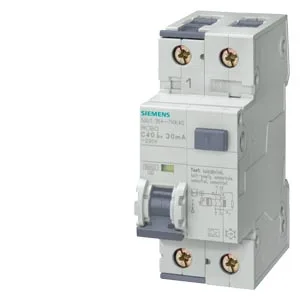
The Siemens 5SU1354-7KV40 is a combined residual-current device and miniature circuit breaker (RCBO) in a 1+N-pole form factor, rated C 40A with 30 mA earth-leakage trip sensitivity and a 10 kA short-circuit breaking capacity. The Type A detection means it catches both sinusoidal AC fault currents and pulsating DC fault currents — the kind you get from single-phase rectifiers in switched-mode power supplies, LED drivers, or VFD front ends. That 30 mA IΔn is the standard for personal protection in most residential and light-commercial circuits (IEC 60364-7-710 for medical locations goes lower, but this is the common spec for socket-outlet circuits in offices and homes).
The 70 mm depth from the mounting rail to the front of the device is a standard dimension that fits most domestic and light-commercial consumer units, but it's worth checking the enclosure depth if you're retrofitting into a shallow panel. The 1+N-pole configuration switches the line conductor and provides neutral disconnection on the residual-current side — the neutral is switched, so it's suitable for single-phase circuits where you need to isolate both poles on a fault. The C-curve (40 A) means the magnetic trip operates at 5 to 10 times rated current (200–400 A), so it's sized for motor-starting or transformer inrush loads that would nuisance-trip a B-curve device.