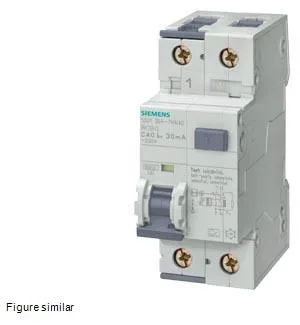
If your panel runs hotter — and many do — the thermal derating kicks in: 30.4 A at 40 °C, 29.76 A at 45 °C, 28.8 A at 50 °C, 27.84 A at 55 °C, 27.2 A at 60 °C, 25.92 A at 65 °C, and 24.64 A at 70 °C. That's a straight line you can interpolate; for a 40 °C panel the effective capacity is 30.4 A, so a 32 A continuous load won't hold. That's appropriate for circuits with a modest inrush — think a few fluorescent fittings, small pumps, or a domestic refrigerator. For highly inductive loads like a large motor start, a D-curve would be a better fit; this isn't that part. Insulation voltage (Ui) is 264 V, surge voltage resistance 4 000 V, overvoltage category III, pollution degree 2 — standard for a distribution board downstream of the main switch.
IP20 with conductors connected. Mounting position any — no restriction on upright or horizontal. Halogen-free and silicon-free construction, so it's fine for clean-room or sensitive-environment panels.