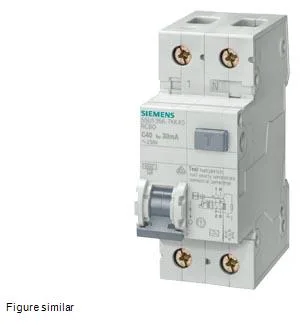
What it is and what it does
The Siemens 5SU1356-6GV16 is a SENTRON RCBO (residual current operated circuit breaker with integral overcurrent protection) in a 2-pole 1P+N configuration. It combines a 16 A rated current with a Type A residual current detection and a B-curve tripping characteristic, so it protects both against overload and short-circuit as well as against sinusoidal AC and pulsating DC residual currents — common on circuits feeding single-phase rectifiers or electronics. Rated breaking capacity is 6 kA per EN 60898 and 15 kA per IEC 60947-2, meaning it can safely interrupt fault currents up to those levels without upstream damage — the higher IEC figure covers industrial panel coordination where higher prospective fault currents are expected. It occupies 2 modular width units (36 mm) on a DIN rail, with a depth of 77 mm and an installation depth of 70 mm. Mounting position is any, and the supply cord can enter from either top or bottom — flexibility for tight panel layouts.
Thermal derating and ambient limits
The 16 A rating holds at 30 °C ambient; at 40 °C it derates to 15.2 A, at 50 °C to 14.4 A, and at 70 °C to 12.32 A. This matters for densely packed enclosures — if the panel ambient runs hot, the actual continuous current the RCBO can carry drops, so size the upstream load accordingly. Operating temperature range spans -40 °C to 75 °C, covering cold storage and hot machine-side installations. Pollution degree 2 and overvoltage category III are standard for fixed-installation distribution boards.
Installation and compliance notes
Rated IP20 with the distribution board installed and conductors connected — not suitable for washdown or outdoor exposure without an enclosure. Halogen-free and silicon-free construction supports use in clean-room or sensitive electronics environments where outgassing must be minimized. Designated as instantaneous (no intentional time delay on the residual current element), so it trips within the standard Type A response window. Energy limitation class 3 means it limits let-through energy during a fault, reducing stress on downstream wiring.
