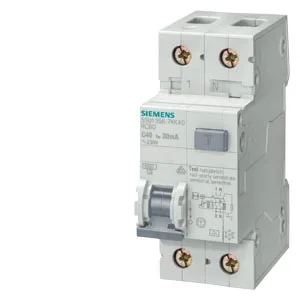
The Siemens 5SU1356-6KV10 is a combined residual-current device and miniature circuit breaker (RCBO) — an FI/LS-protector in Siemens' terminology. It integrates Type A residual-current detection at 30 mA with a B-curve overcurrent trip at 10 A, all in a 1+N-pole, 6 kA breaking-capacity package. The 30 mA IΔn is the standard threshold for personal protection against direct contact (per IEC 60364), while the B-curve 10 A trips between 3 and 5 times rated current for resistive or low-surge loads. The 70 mm depth (D=70mm) is a standard modular dimension for Siemens' 5SU series, fitting into their distribution boards and enclosures without overhang. The Type A residual-current detection covers pulsating DC faults (from rectified loads like electronics or LED drivers) in addition to sinusoidal AC — a requirement for circuits feeding single-phase power supplies or appliances with rectifiers.
Deployment context
The Type A residual-current detection is the deciding factor for circuits with electronic loads — if the downstream equipment includes switched-mode power supplies, LED drivers, or variable-speed drives, a Type A device is required over a basic Type AC. The B-curve 10 A is suited for lighting circuits, socket outlets in residential or light commercial use, and control transformers where inrush is modest.