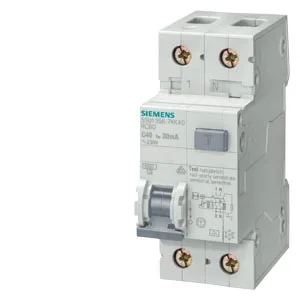
The Siemens 5SU1356-7KV40 is a combined RCD/MCB — an FI/LS protector — in a Type A (PSE/SSF) configuration. It packs a 40 A C-curve overcurrent trip and a 30 mA residual-current detection into a single 1+N-pole, 70 mm-wide module.
Type A detects AC sinusoidal and pulsed DC residual currents up to 6 mA smooth DC superimposed. Rated current In = 40 A with C-curve characteristic: the magnetic release trips at 5–10× In (200–400 A), so it handles motor inrush and capacitive loads without nuisance tripping. The 40 A rating matches a 7.5 kW resistive load at 230 V or a 9 kVA inductive load — typical for a cooker circuit, a large shower, or a submain feeding a small workshop. The 1+N-pole form switches the phase and disconnects the neutral; the neutral pole is switched but not protected against overcurrent, which is standard for single-phase final circuits in TN-S and TT systems. Breaking capacity Icn = 6 kA per IEC 61009-1: this is the prospective short-circuit current the device can interrupt at its rated voltage.