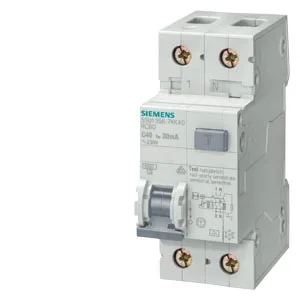
Breaking capacity is 6kA, which covers most domestic and light commercial sub-distribution boards. The 70mm width (4 module spaces) is standard for this class of 1+N RCBO — fits DIN-rail enclosures without crowding adjacent ways. For the sourcing buyer: this is a current-production part, so no lifecycle risk on a new BOM line.
The 300mA IΔn (residual operating current) means this unit is sized for protection against fire risk from earth faults, not direct personal shock protection (that's the 30mA class). Type AC detection covers sinusoidal AC residual currents — fine for general-purpose circuits feeding socket outlets, lighting, and resistive loads, but not for inverter-fed or electronically smoothed loads that produce pulsating DC or high-frequency residuals. If the downstream load includes VFDs, LED drivers, or switched-mode supplies, a Type A or Type F RCD would be the correct choice. The 6kA breaking capacity (Icn) is the short-circuit current the device can safely interrupt. If the board is close to a large transformer or in an industrial supply with higher fault levels, you'd need a 10kA or higher-rated unit. That's the standard curve for residential and commercial lighting and socket-outlet circuits where inrush is modest. It's not intended for motor or transformer starting loads — those would need a C-curve or D-curve to avoid nuisance tripping on inrush.
No minimum quantity constraints typical of factory-direct programs. Current pricing and lead time confirmed at quote time.