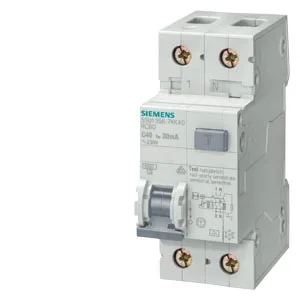
Siemens 5SU1656-1KV40 — Residual Current Breakers (RCCB/RCBO)

Siemens 5SU1656-1KV40 RCBO, Type AC 300mA, 6kA, 1+N C 40A

MPN5SU1656-1KV40

Siemens 5SU1656-1KV40 FI/LS-PROTECTOR, Type AC (WS), D=70mm, IΔn 300mA, 6kA, 1+N-pole, C 40A.

StockContact for availability
MOQ1 pcs
Sourced new & surplus through independent channelsListing updated Jul 2026

Product details

What this RCBO does in the panel

The Siemens 5SU1656-1KV40 is a combined residual-current and overcurrent protective device (RCBO) — what Siemens calls an FI/LS protector. It packs a Type AC residual-current unit rated at 300 mA trip threshold and a C-curve 40 A miniature circuit breaker into a single 1+N-pole module, 70 mm wide on the DIN rail. That 6 kA breaking capacity handles fault currents up to that level at the service entrance or sub-distribution board where the prospective short-circuit current stays within that range.

Ratings that decide fit

The C-curve means the magnetic trip fires at 5 to 10 times rated current — 200 A to 400 A — which suits motor-starting and transformer inrush loads that would nuisance-trip a B-curve. The 40 A thermal element carries continuous loads up to that current. The 300 mA residual threshold is a deliberate choice: it is higher than the 30 mA required for personal shock protection, so it is typically specified for circuits where the natural leakage from filters, VFDs, or long cable runs would cause unwanted trips on a 30 mA device. This makes it a fit for distribution sub-mains, lighting circuits with electronic ballasts, or equipment circuits where the earth leakage budget is tight. Type AC detection means it responds to sinusoidal AC residual currents only. Pulsating DC residuals (from rectifiers, half-wave devices, or VFDs) will not reliably trip this device — that is the limitation of Type AC. If the downstream load includes any power electronics, a Type A or Type F RCD would be the correct choice. The 6 kA breaking capacity is the rated short-circuit withstand; for installations with higher prospective fault current, upstream current-limiting fuses or a higher-rated breaker would be needed to keep the let-through energy within the device's limits.

Frequently asked questions

What is the 5SU1656-1KV40 used for?

It is a combined residual-current and overcurrent protector (RCBO) for 1+N circuits, rated 40 A C-curve with 300 mA Type AC residual detection and 6 kA breaking capacity. It protects against both overload/short-circuit and sinusoidal earth faults in a single DIN-rail module.

Where can I buy the 5SU1656-1KV40?

This part is sourced and quoted to order against an RFQ through independent distribution. Availability and current pricing are confirmed at quote time.

What does Type AC mean on this RCBO?

Type AC means it detects sinusoidal AC residual currents only. It will not reliably trip on pulsating DC residuals from rectifiers, VFDs, or half-wave devices — for those loads, a Type A or Type F RCD is required.

What is the difference between a 30 mA and 300 mA RCD?

30 mA is the threshold for personal shock protection. 300 mA is for fire protection and equipment protection on circuits with naturally higher earth leakage — it avoids nuisance tripping on VFDs, filters, or long cable runs where the leakage budget is tight.

MPN
5SU1656-1KV40