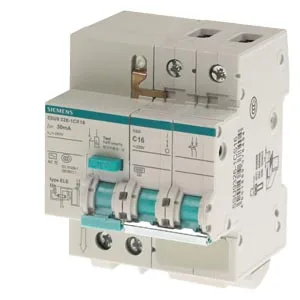
What it is and what it does
The Siemens 5SU9326-1CR06 is a 2-pole RCD-operated circuit breaker (RCBO) from the SENTRON 5SU9 series, combining overcurrent protection and residual current detection in a single 4-module (72 mm) wide unit. It is rated for 6 A at 30 °C with a C tripping curve, meaning it handles moderate inrush from motor or lighting loads without nuisance trips while still clearing faults quickly. The Type AC fault current detection covers sinusoidal AC residual currents — the standard choice for general-purpose circuits where pulsed or DC fault currents are not expected.
Breaking capacity and coordination
Rated breaking capacity is 6 kA per both EN 60898 and IEC 60947-2 at 400 V AC. That is the standard domestic and light commercial SCCR for a final subcircuit RCBO — adequate for most distribution boards where the prospective fault current at the board is under 6 kA. If your panel has a higher fault level upstream, you will need a current-limiting upstream breaker or a device with a higher Icn rating. The energy limiting class is 3, which means it restricts let-through energy well enough to protect downstream wiring in a selective coordination scheme.
Current derating and thermal limits
The 6 A rating is at 30 °C ambient. The unit derates to 5.3 A at 40 °C, 5.2 A at 45 °C, 4.9 A at 50 °C, and 4.6 A at 55 °C. If the breaker lives in a hot enclosure — near other heat sources or in a non-ventilated panel — size the load to the derated figure, not the 30 °C headline. The mounting position is any, so it can be installed horizontally or vertically without further derating, provided the enclosure ambient stays within the -40 °C to +75 °C range.
Physical fit and installation
Width is 72 mm (4 width units at 18 mm per module), depth is 77 mm, and installation depth is 70 mm. It snaps onto a standard DIN rail and accepts supply from either top or bottom. The IP20 rating applies when installed in a distribution board with conductors connected — normal for enclosed panel use, not for open wet-area mounting. Halogen-free and silicon-free construction matters for environments where outgassing during a fault could damage electronics or contaminate clean processes.