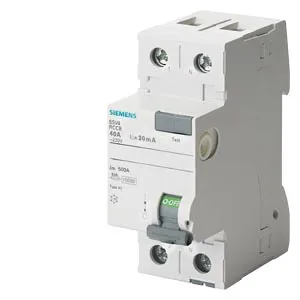
RCCB for general-purpose residual current protection
The 5SV4312-0KK13: The 30 mA trip threshold catches earth-leakage faults down to that level, which is the standard for personal protection against direct contact in residential and commercial final circuits. Type AC means it responds to sinusoidal residual currents only — not pulsed DC or smooth DC — so it fits circuits with purely resistive or inductive loads, not variable-speed drives or rectifier-fed equipment.
Panel integration and mounting
Snaps onto a DIN rail (REG) and can be mounted in any position. The 70 mm installation depth matches the standard SENTRON modular depth, so it aligns with adjacent MCBs and other DIN-rail components in the same enclosure. Supply can enter from top or bottom, which simplifies busbar routing. IP20 rating applies when the distribution board is installed with conductors connected — normal for enclosed panels. Overvoltage Category III means it's rated for fixed installation downstream of the main distribution board, not for outdoor or wet-location use without additional enclosure.
Electrical ratings and fault handling
Short-circuit current rating (SCCR) is 10 kA per IEC 61008-1, meaning it can safely interrupt a fault current up to that level without welding contacts or rupturing the case. The rated conditional short-circuit current with a series fuse is 63 A maximum — if a higher prospective fault current exists upstream, a current-limiting MCB or fuse must coordinate ahead of this RCCB. Mechanical service life is 10 000 operating cycles typical. Power loss per pole at rated current in hot operating state is 1 W, so two-pole dissipation is 2 W — negligible for thermal budgeting inside a panel. Operating ambient range is -25 °C to 45 °C; storage range extends to -40 °C. The 50 Hz supply frequency is fixed — not suitable for 60 Hz systems. Silicon-free construction matters for automotive or high-reliability environments where silicone outgassing can contaminate contacts or optics.