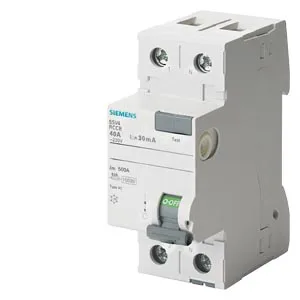
It is short-time delayed, so it withstands brief inrush or leakage spikes that would nuisance-trip a standard instantaneous RCCB — useful on circuits with capacitive loads or long cable runs where the charging current might otherwise knock the breaker out on energisation.
The 30 mA trip covers the standard personnel-protection threshold (IΔn ≤ 30 mA per IEC 60364). Short-circuit breaking capacity is 10 kA per IEC 61008-1, with a conditional rating of 0.5 kA per EN 60898. The let-through energy (I²t) is capped at 58 000 A²·s, which keeps downstream components safe during a fault. If your load includes VFDs, UPS systems, or rectifiers that generate DC fault components, you need a Type A or Type B RCCB instead. For standard resistive or inductive AC loads (heaters, contactors, lighting), Type AC is the correct choice.
Depth is 70 mm, height 90 mm. Mounting position is any orientation. Silicon-free construction (per the spec) matters if this goes into a paint shop or coating line where silicone outgassing causes fisheyes in the finish.