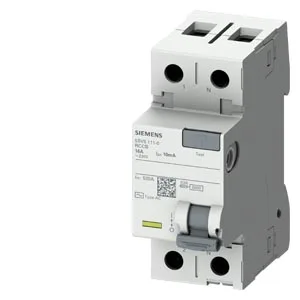
The Siemens SENTRON 5SV5111-0 is a 2-pole residual current operated circuit breaker (RCCB) rated 16 A at 230/400 VAC, 50 Hz, with a 10 mA trip threshold and Type AC waveform detection. It protects against earth faults by disconnecting both poles when leakage exceeds 10 mA — sized for circuits where very low leakage is the safety threshold, like wet locations or equipment with sensitive ground-fault requirements.
The 10 mA trip is unusually sensitive; standard RCCBs are 30 mA. That means it catches leakage currents a 30 mA device would miss, but it also risks nuisance tripping on circuits with normal capacitive leakage (long cable runs, surge suppressors). Use it where 10 mA is code-mandated or the equipment requires it — not as a general-purpose replacement for a 30 mA RCCB. Short-circuit withstand is 6 kA per IEC 61008-1. The let-through energy is capped at 58 000 A²·s and peak let-through current at 5 200 A — numbers a panel designer uses to coordinate with the upstream MCB or fuse so the RCCB isn't asked to clear a fault beyond its rating. The maximum permissible series fuse is 63 A. Type AC detection means it trips on sinusoidal residual AC current only. It will not detect pulsating DC or smooth DC faults — if the load includes rectifiers, VFDs, or switching power supplies, a Type A or Type B RCCB is the correct choice. This part is for plain AC circuits with no electronic load generating DC fault content.
Snaps onto DIN rail (REG) — 36 mm wide, 2 modular-width units. Depth is 70 mm, installation depth the same. Grid spacing is 60 mm, the standard DIN pitch for enclosure cutouts. Mounting position is any orientation; supply can enter top or bottom.