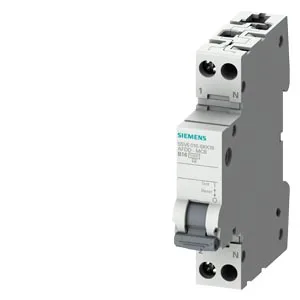
AFDD + MCB in one module — what it means for the panel
The Siemens SENTRON 5SV6016-6KK13 combines an arc-fault detection device (AFDD) and a miniature circuit breaker (MCB) in a single 18 mm wide, 1-module-width housing. It protects a 13 A final circuit at 230 V AC against both overload/short-circuit (B-curve, 6 kA per IEC 60947-2 and EN 60898-1) and series or parallel arc faults.
Where it fits — DIN-rail integration and environment
Snaps onto standard DIN rail (REG) and occupies one modular width (18 mm). Depth is 68.5 mm; installation depth 70 mm — shallow enough to clear most enclosure gland plates without a spacer. Mounting position is unrestricted, so it can go sideways or upside-down in a tight gland-plate layout.
Arc-fault detection range — what the ratings actually mean
The AFDD electronics are rated to detect series arcs (e.g., a loose terminal or nicked conductor) between 2 A and 13 A, and parallel arcs (line-to-neutral or line-to-ground faults) between 50 A and 500 A. Below 2 A series arc, the unit may not trip — that is normal for the technology; a glowing connection that draws under 2 A is a fire risk the AFDD is not designed to catch. The 50 A minimum for parallel arcs means very low-impedance faults still get cleared by the magnetic trip of the MCB, not the arc detection. The device is halogen-free and silicon-free throughout, so it won't outgas corrosive compounds in a clean environment or near sensitive electronics.