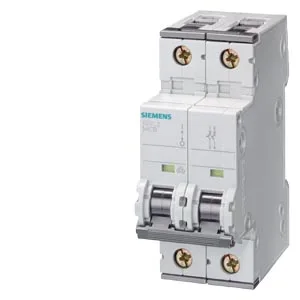
The Siemens 5SY4240-7CV is a 2-pole miniature circuit breaker (MCB) with a C-curve trip characteristic rated at 40 A. Its interrupting capacity is 15 kA at 400 V AC, which means it can safely clear a bolted fault up to that level without welding its contacts or rupturing the arc chamber — a spec that matters when coordinating downstream branch protection in a panel. The C-curve (trip threshold 5–10× In) suits it for mixed resistive and moderate inductive loads where inrush isn't extreme — think motor control circuits, lighting banks, or general distribution subfeeds. The 2-pole form factor snaps onto standard DIN rail and occupies two module widths in the enclosure.
What the ratings mean for fit
The 15 kA breaking capacity at 400 V AC governs selective coordination. The 40 A C-curve rating means the thermal-magnetic trip holds continuous current up to 40 A and trips instantaneously between 200 A and 400 A. For a 40 A feeder, that's standard; for a motor circuit drawing 38 A full-load, check that the starting inrush (typically 6–8× FLA for a brief cycle) stays under the magnetic trip threshold to avoid nuisance tripping on startup.