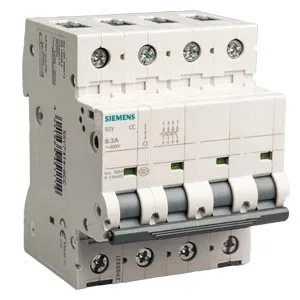
What this 4-pole C-curve MCB does on the line
It's built for 400 V AC circuits and carries a 10 kA breaking capacity per EN 60898, with a 5 kA rating per UL 1077 and CSA C22.2 No.235. That C-curve means it's sized for moderate inrush loads — motors, transformers, capacitor banks — where the start-up surge is higher than a resistive load but not extreme. Mount it any position, any orientation; it's rated for ambient temperatures from -25 to +55 °C and storage down to -40 °C. That's a real-world panel range, not a lab number.
Integration and compliance notes
The breaker is 72 mm wide (4 width units), 90 mm tall, and 76 mm deep, with an installation depth of 70 mm. It's sealable, halogen-free, silicon-free, and carries touch protection (IP20 with connected conductors). That IP20 rating is standard for a panel-mounted device — it keeps fingers out but isn't rated for washdown. Energy limiting class 3 gives good let-through energy reduction on faults, which helps with downstream coordination.
Delta against a common sibling: 5SY3132-6
A buyer often asks whether the 5SY4613-7CC drops into a panel wired for the 5SY3132-6. The short answer: no, not without rewiring. The 5SY4613-7CC is a 4-pole (3P+N) breaker; the 5SY3132-6 is a 3-pole unit. The physical footprint is wider (4 width units vs 3), and the terminal layout differs. Both are SENTRON 5SY-series MCBs with a C-curve, but the pole count is the hard stop. If your panel was laid out for a 3-pole breaker, this one won't fit the same DIN-rail slot without a new busbar and re-termination.